
Few dental treatments come with as much fear as a root canal. Most of that fear is based on stories from decades ago, jokes in TV shows, or rumours that have nothing to do with how the procedure works today.
The reality is much calmer. With modern anesthetic and tools, a root canal is a standard procedure that saves a tooth that would otherwise need to come out. If you live or work in Downtown Vancouver and your dentist has mentioned a possible root canal, this guide explains what actually happens, what does not, and what to expect.
Why root canals have such a bad reputation
Two reasons. First, the procedure used to be much less comfortable than it is today. Anesthetic, instruments, and imaging were less advanced. Second, the pain people remember is usually the pain of the infection or inflammation that led to the root canal in the first place. The procedure is what relieves that pain.
Modern root canals are routine in dental practice. They are done every day, in every dental clinic, with high success rates and limited downtime.
What a root canal actually is
Inside every tooth is a soft tissue called the pulp. The pulp contains nerves and blood vessels. When the pulp becomes deeply inflamed or infected, you may feel:
- Lingering pain after hot or cold drinks
- Pain when biting or chewing
- An ache that returns at night
- A pimple-like bump on the gum
- Tenderness or swelling in the gum near a tooth
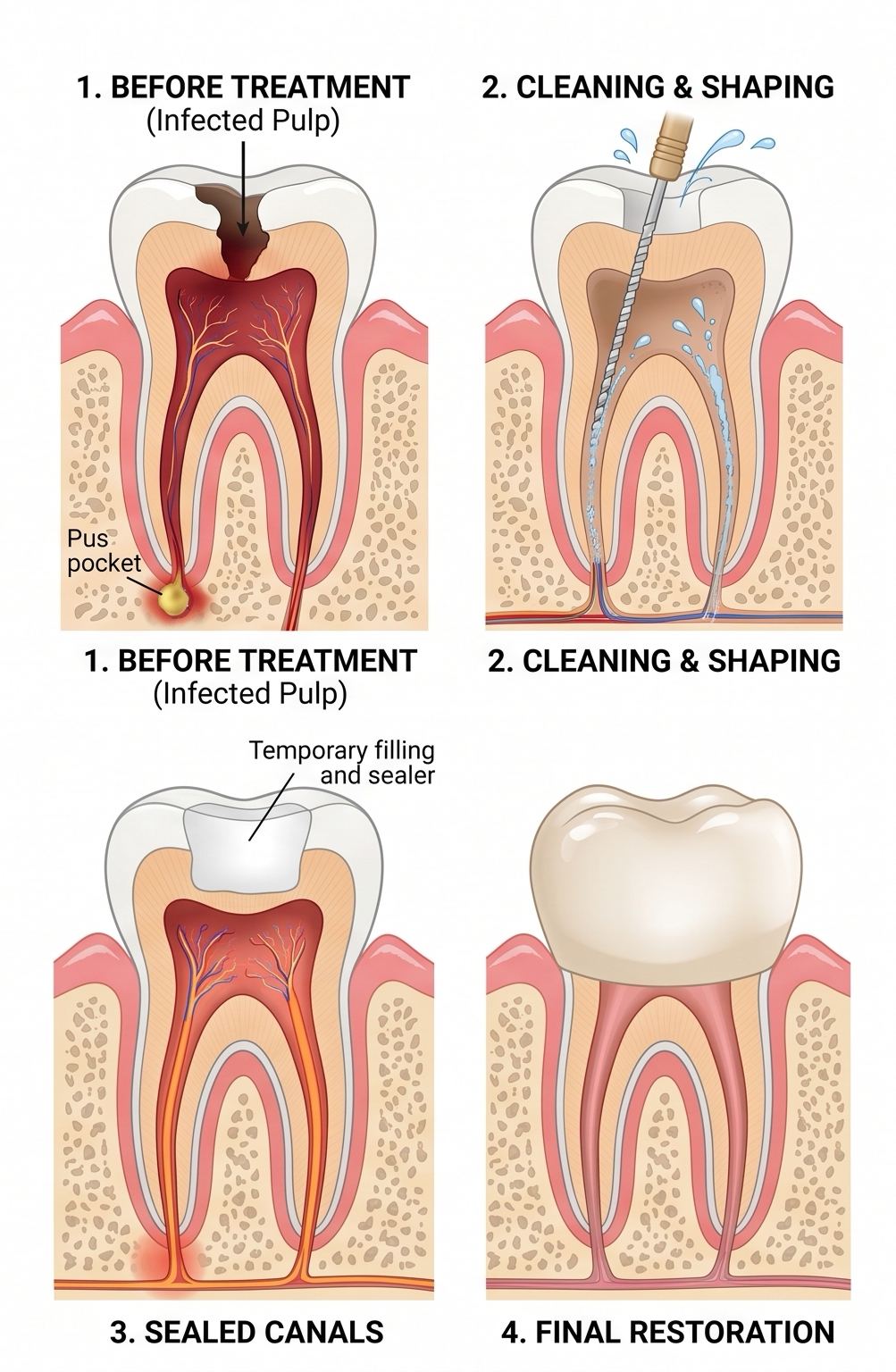
Once the pulp is significantly damaged, it cannot heal on its own. A root canal removes the damaged tissue, cleans the canals inside the tooth, fills them with a sealing material, and seals the tooth from the top. The natural tooth structure stays in your mouth and continues to function.
Common myths vs reality
“Root canals are extremely painful.”
Reality
Root canals are done with local anesthetic. The tooth and surrounding gum are fully numb during the procedure. Most patients describe the experience as similar to having a deep filling. The pain that often gets associated with root canals is actually the pain of the underlying infection or inflammation, which the procedure relieves.
“Root canals make you sick or cause illness.”
Reality
This idea comes from research from the early 1900s that has since been thoroughly debunked. Modern research and major dental and medical bodies have repeatedly confirmed there is no evidence that root canal treatment causes systemic illness. The procedure removes infection rather than spreading it.
“It is better to just pull the tooth.”
Reality
In most cases, keeping your natural tooth is the better choice. A natural tooth supports the bone around it, your bite, and the teeth next to it. Once you remove a tooth, you usually need to replace it with an implant, bridge, or partial denture, which is more involved and often costs more in the long run.
“Root canals do not last.”
Reality
Studies show root canal success rates between 85 and 97 percent when the tooth is properly restored, usually with a crown, and the patient maintains good oral care. Many root-canal-treated teeth last for decades.
“A root canal kills the tooth.”
Reality
A root canal removes the damaged pulp from inside the tooth, but the outer structure stays in your mouth. It still chews. It still looks like a tooth. Without the procedure, that tooth would likely need to be removed entirely. The root canal is what saves it.
What actually happens: step by step
Step 1: Diagnosis and X-rays
Your dentist examines the tooth, tests how it responds to cold and pressure, and takes X-rays to see inside the tooth and around the root tips. The goal is to confirm whether the pulp is the source of the problem and to plan the procedure carefully.
Step 2: Local anesthetic
The area is numbed with a local anesthetic. Your dentist makes sure the tooth and gum feel completely numb before any work begins. If anxiety is a concern, options like sedation dentistry can be discussed in advance to help you feel more relaxed.
Step 3: Isolating the tooth
A small protective sheet, called a rubber dam, is placed over the tooth. This keeps the tooth dry and clean, prevents anything from going down the throat, and keeps bacteria from the rest of the mouth out of the canals.
Step 4: Access opening
Your dentist makes a small opening through the top of the tooth to reach the pulp chamber. This is similar to preparing a tooth for a filling and is not something you feel because you are numb.
Step 5: Cleaning and shaping the canals
Special small instruments and rinses are used to remove the damaged pulp tissue from the canals inside the roots, then to clean and gently shape them. This is the technical heart of the procedure. The dentist may take additional images during the visit to confirm the work.
Step 6: Filling and sealing
Once the canals are clean, they are filled with a rubber-like material called gutta-percha and a sealer. This blocks bacteria from re-entering. The opening on top of the tooth is then closed with a temporary or permanent filling material.
Step 7: Final restoration with a crown
For most back teeth, the next step is placing a custom dental crown at a follow-up visit. The crown protects the tooth from cracking under chewing forces and is the most reliable way to make the result last for years.
What to expect during and after a root canal
How long does the procedure take?
Most root canals are completed in one or two appointments. Each appointment usually lasts 60 to 90 minutes. Front teeth tend to be faster because they have one canal. Back molars take longer because they have multiple canals. Some complex cases may be referred to a specialist called an endodontist.
How it feels during the procedure
You should not feel pain. You may feel pressure or vibration from the instruments, similar to a filling. The numbness usually wears off over a few hours after the visit. If you ever feel discomfort during a procedure, raise your hand. Your dentist can pause and add more anesthetic. You should not need to “tough it out”.
How it feels after the procedure
Mild tenderness for 2 to 4 days is common, especially when biting on the treated tooth. This usually responds well to over-the-counter pain medication. The tooth often feels notably better than before the procedure because the source of the infection or inflammation has been removed. Most patients return to work the same day or the next morning. There are no surgical incisions or stitches in a routine root canal.
Recovery tips for the first week
- Avoid chewing directly on the treated tooth until any temporary filling is replaced and a crown is placed
- Take any prescribed medication as instructed
- Keep brushing and flossing as normal, gently around the treated area
- Schedule the crown placement as soon as your dentist recommends, often within 2 to 4 weeks
- If discomfort lasts more than a week or gets worse, let your dentist know
When you might need a root canal
Common reasons your dentist may recommend one
- A deep cavity that has reached the nerve
- A cracked tooth that has exposed the pulp
- Repeated dental work on the same tooth that has irritated the pulp
- Trauma that has injured the tooth, even years earlier
- An abscess on the gum near the root of the tooth
Catching these issues early at a routine dental checkup often gives you more options and can sometimes prevent the need for a root canal in the first place.
Signs you should book a dental visit soon
Book a visit if you have lingering pain after hot or cold drinks, one tooth that is becoming sensitive to chewing pressure, an old filling or crown that feels rough or loose, a tooth that has darkened compared to its neighbours, or a small bump or pimple on the gum.
When to seek urgent care
Seek urgent care for facial swelling or fever, severe tooth pain with a foul taste, pain that wakes you up and is not controlled by over-the-counter medication, or difficulty swallowing or breathing. These can signal a spreading infection. Contact us right away for emergency dentistry.
What comes after the root canal
Why a crown is usually the next step
After a root canal, the tooth is structurally weaker than a healthy tooth because its inner support has been cleaned out. Back teeth in particular are at higher risk of cracking under normal chewing forces. A crown fits over the entire visible tooth, restores full strength, and protects the work that was just done. Skipping the crown is one of the most common reasons a root-canal-treated tooth fails years later.
What happens if you wait or skip the procedure
If a tooth needs a root canal and the procedure is delayed, the infection can spread, the tooth can crack further, or an abscess can develop. At that point, the tooth often needs to be removed. Replacing it later with a bridge, an implant, or a denture is a bigger commitment. Treating the issue early is usually the simpler and longer-lasting choice.
Why patients trust us with root canal treatment
We focus on making the experience calm, clear, and well-numbed. Our Downtown Vancouver team explains what we see, why a root canal is or is not the right choice, and walks you through each step at your own pace. If sedation will help you relax, we offer it.
Our clinic offers transparent fees, direct billing with most insurance providers, CDCP support where eligible, and follow-up care to make sure your treated tooth is restored properly with a crown.
Worried you might need a root canal?
Book a focused exam with our Downtown Vancouver team. We will examine the tooth, take the right images, and explain your options without pressure.
Frequently asked questions
Are root canals really painful?
Most patients say a root canal feels similar to getting a filling. Modern local anesthetic numbs the area before any work begins. The pain people often associate with root canals is actually from the infection or inflammation that the procedure relieves.
How long does a root canal take?
Most root canals are completed in one or two appointments, each lasting about 60 to 90 minutes. Front teeth are often quicker because they have one canal. Back teeth can take longer because they have multiple canals.
Why do I need a crown after a root canal?
After a root canal, the tooth becomes more brittle because its inner structure has been hollowed out and sealed. A crown protects the tooth from cracking, restores full chewing strength, and is the most reliable way to make the result last for many years.
Is it better to pull the tooth instead of a root canal?
In most cases, keeping your natural tooth is better. A natural tooth supports your bone, your bite, and the teeth next to it. Replacing a missing tooth with a bridge or implant is also more involved and usually more expensive than a root canal followed by a crown.
How long does a root canal last?
When the tooth is restored properly with a crown and the patient maintains good oral care, root-canal-treated teeth often last 10 years or much longer. Studies show success rates between 85 and 97 percent for well-completed cases.
Do root canals make you sick?
No. The idea that root canals cause systemic illness comes from research from the early 1900s that has since been thoroughly debunked. Modern dental and medical research confirms there is no evidence root canals cause disease. The procedure removes infection rather than spreading it.
This article is for general information only and does not replace personal advice from your dentist. If you have severe pain, swelling, fever, or signs of infection, seek prompt dental or medical care.